

reseña de libro
metadatos
cartas al editor
metadatos
cartas al editor
restringido
cartas al editor
restringido
artículo original
restringido
artículo original
restringido
artículo original
restringido
artículo original
restringido
Artículo original
metadatos
artículo original
restringido
artículo original
abierto
artículo original
abierto
artículo original
abierto
artículo original
abierto
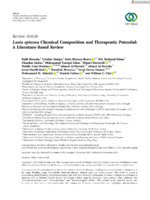
"Lasia spinosa (L.) is used ethnobotanically for the treatment of various diseases, including rheumatoid arthritis, inflammation of the lungs, bleeding cough, hemorrhoids, intestinal diseases, stomach pain, and uterine cancer. This review is aimed at summarizing phytochemistry and pharmacological data with their molecular mechanisms of action. A search was performed in databases such as PubMed, Science Direct, and Google Scholar using the keywords: ""Lasia spinosa,"" then combined with ""ethnopharmacological use,"" ""phytochemistry,"" and ""pharmacological activity."" This updated review included studies with in vitro, ex vivo, and in vivo experiments with compounds of known concentration and highlighted pharmacological mechanisms. The research results showed that L. spinosa contains many important nutritional and phytochemical components such as alkanes, aldehydes, alkaloids, carotenoids, flavonoids, fatty acids, ketones, lignans, phenolics, terpenoids, steroids, and volatile oil with excellent bioactivity. The importance of this review lies in the fact that scientific pharmacological evidence supports the fact that the plant has antioxidant, anti-inflammatory, antimicrobial, cytotoxic, antidiarrheal, antihelminthic, antidiabetic, antihyperlipidemic, and antinociceptive effects, while protecting the gastrointestinal system and reproductive. Regarding future toxicological and safety data, more research is needed, including studies on human subjects. In light of these data, L. spinosa can be considered a medicinal plant with effective bioactives for the adjuvant treatment of various diseases in humans."
abierto
artículo original
abierto
Artículo original
metadatos
Artículo original
metadatos
actas de conferencia
abierto
artículo original
abierto
artículo original
abierto
artículo original
metadatos
artículo original
abierto
artículo original
restringido
Autores: CONTRERAS, C
reseña de libro
metadatos
Autores: DEARETXABALA, Xabier
cartas al editor
metadatos
Autores: DEARETXABALA, X
cartas al editor
restringido
Autores: ROA, I
cartas al editor
restringido
Autores: de Aretxabala, XA
artículo original
restringido
Autores: Manterola, C
artículo original
restringido
Autores: Celis, R
artículo original
restringido
Autores: ROA, I
artículo original
restringido
Autores: Manterola, Carlos
Artículo original
metadatos
Autores: Manterola, Carlos
artículo original
restringido
Autores: Chen, Ningsheng
artículo original
abierto
Autores: del Sol, Mariano
artículo original
abierto
Autores: Vallejos-Romero, Arturo
artículo original
abierto
Autores: Herrera-Balboa, Samuel
artículo original
abierto
Autores: Raul Allard, S.
artículo original
abierto
Autores: Otero, Adriana Maria
artículo original
abierto
Autores: Jellal, Ahmed
artículo original
otro
Autores: Cruz-Martins, Natalia
"Lasia spinosa (L.) is used ethnobotanically for the treatment of various diseases, including rheumatoid arthritis, inflammation of the lungs, bleeding cough, hemorrhoids, intestinal diseases, stomach pain, and uterine cancer. This review is aimed at summarizing phytochemistry and pharmacological data with their molecular mechanisms of action. A search was performed in databases such as PubMed, Science Direct, and Google Scholar using the keywords: ""Lasia spinosa,"" then combined with ""ethnopharmacological use,"" ""phytochemistry,"" and ""pharmacological activity."" This updated review included studies with in vitro, ex vivo, and in vivo experiments with compounds of known concentration and highlighted pharmacological mechanisms. The research results showed that L. spinosa contains many important nutritional and phytochemical components such as alkanes, aldehydes, alkaloids, carotenoids, flavonoids, fatty acids, ketones, lignans, phenolics, terpenoids, steroids, and volatile oil with excellent bioactivity. The importance of this review lies in the fact that scientific pharmacological evidence supports the fact that the plant has antioxidant, anti-inflammatory, antimicrobial, cytotoxic, antidiarrheal, antihelminthic, antidiabetic, antihyperlipidemic, and antinociceptive effects, while protecting the gastrointestinal system and reproductive. Regarding future toxicological and safety data, more research is needed, including studies on human subjects. In light of these data, L. spinosa can be considered a medicinal plant with effective bioactives for the adjuvant treatment of various diseases in humans."
abierto
Autores: Olate, Sergio
artículo original
abierto

Autores: Salvo-Garrido, Sonia
artículo original
abierto
Autores: Dronova, Iryna
artículo original
abierto
Autores: Lanas, Fernando
artículo original
metadatos
Autores: Bonfill, Xavier
artículo original
metadatos
Autores: De la Puente, Catherine
artículo original
metadatos
Autores: Lanas, Fernando
artículo original
metadatos
Artículo original
metadatos
Autores: Lopez-Jaramillo, Patricio
artículo original
metadatos
Autores: Fonseca, Gabriel M.
artículo de revisión
abierto
Autores: Guerrero-Rascado, Juan Luis
Artículo original
metadatos
Autores: Laroze, David
artículo original
otro
Autores: Romero, Ivonne
artículo original
otro
Autores: Smith, Peter B
actas de conferencia
abierto
Autores: Saez, Patricia L.
artículo original
otro
Autores: Delgado, M.
artículo original
restringido
Autores: Alberdi, M.
abierto
Autores: Gallardo-Cerda, Jorge
Artículo original
abierto
Autores: Mandarim-de-Lacerda, Carlos Alberto
artículo original
abierto
Autores: Yarimizu, Kyoko
artículo de revisión
abierto
Autores: Rojas-Mancilla, Edgardo
artículo original
abierto
Autores: Dieguez-Rebolledo, Mauricio
artículo de revisión
abierto
Autores: Brun, Mario
abierto
Autores: Alonqueo, Paula
artículo original
metadatos
Autores: Sanchez, Raul
artículo original
abierto
Autores: Olate, Sergio
abierto
Autores: Marino, Rodrigo J.
artículo original
abierto
Autores: Fazio, Rodolfo
artículo original
abierto
Autores: Fazio, Rodolfo
artículo original
abierto
Autores: Negron, Cecilia Paredes
artículo original
restringido